
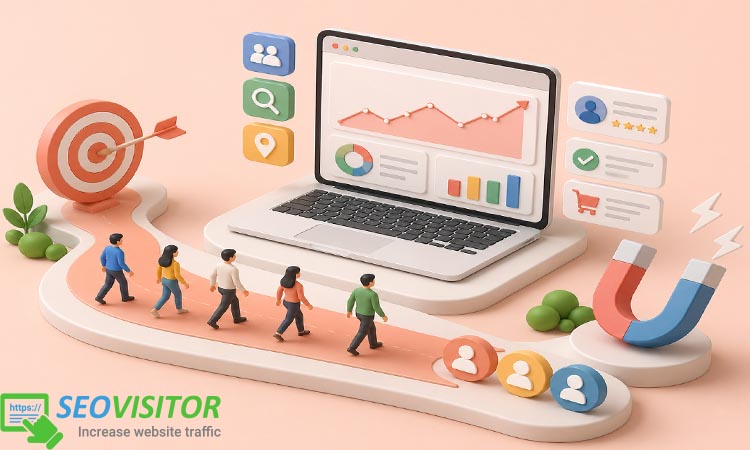
A practical framework for finding visitors who match your offer, measuring their value, and improving traffic quality without chasing vanity metrics.
A rise in sessions can look impressive while sales, leads, and subscriptions remain unchanged. The problem is often not a lack of traffic. It is a mismatch between the people arriving, the reason they clicked, and the action the website expects them to take.
Targeted traffic is not simply traffic from a particular country or advertising channel. It is traffic from people whose needs, intent, location, and buying stage align with the offer on the page. When that alignment is strong, a smaller audience can create more business value than a much larger group of accidental visitors.
Targeted Traffic and Random Traffic Are Not the Same
A targeted visitor arrives with a relevant problem or goal. The visitor may be comparing solutions, checking prices, researching a topic connected to your service, or returning to complete a decision. Random traffic arrives without that connection—perhaps because of a misleading headline, an overly broad keyword, weak campaign targeting, or an irrelevant referral source.
The difference should be evaluated through behavior and outcomes rather than assumptions. A visitor is not qualified merely because the session lasts a long time, and a short visit is not always low quality. Someone who quickly finds a phone number and calls may be more valuable than someone who reads for ten minutes and never takes the next step. For businesses exploring targeted web traffic options, this distinction can help determine whether additional visitors are actually reaching the right audience or simply increasing session volume.
| Signal | Targeted traffic | Random or poorly matched traffic |
| Intent | The visit has a clear connection to the offer or topic. | The visit is accidental, curious, or unrelated to the offer. |
| Page behavior | The user reaches relevant sections and meaningful next steps. | The user leaves because the content does not match the expectation. |
| Conversion potential | The session can reasonably lead to a qualified action. | Even high session volume has little connection to a business outcome. |
| Measurement | Quality is judged by source, intent, engagement, and conversion together. | Success is judged mainly by pageviews or session count. |
This comparison is a diagnostic guide, not a universal industry benchmark.
Why Better Traffic Usually Beats More Traffic
Traffic volume matters only after relevance is established. A campaign that attracts thousands of people who cannot use the product, do not understand the offer, or are outside the service area creates reporting activity—not growth. By contrast, a smaller campaign aimed at a clearly defined audience gives the business cleaner feedback about its message, landing page, and offer.
Consider a hypothetical example. Campaign A brings 10,000 visits and produces five qualified leads. Campaign B brings 1,000 visits and produces twenty qualified leads. Campaign B has less traffic, but it creates more opportunities and gives the team a more useful signal about what customers respond to. The correct conclusion is not that every small campaign is better; it is that sessions must be interpreted alongside qualified actions and customer value.
Key takeaway: Choose channels and keywords by their ability to reach the right audience—not by the largest traffic estimate.
Define the Audience Before You Drive Traffic
Start With the Customer and the Job They Need to Complete
An ideal customer profile should go beyond age, job title, or company size. Define the problem the customer is trying to solve, the trigger that makes the problem urgent, the barriers that delay a decision, and the evidence required to trust a provider. For a B2B service, this may include budget authority and implementation constraints. For an online store, it may include delivery region, product compatibility, price sensitivity, and return expectations.
Map Search Intent to the Right Page
Informational searches usually need an explanation or guide. Commercial searches need comparisons, proof, and clear differentiation. Transactional searches need a focused landing page with pricing, availability, and an obvious next step. Sending every query to the homepage weakens relevance because the visitor must work too hard to find the expected answer.
Include Geographic and Operational Constraints
A visitor can match the topic and still be unqualified if the business cannot serve the visitor’s country, language, device, budget, or delivery needs. These constraints should be part of audience targeting from the start rather than discovered after money has been spent.
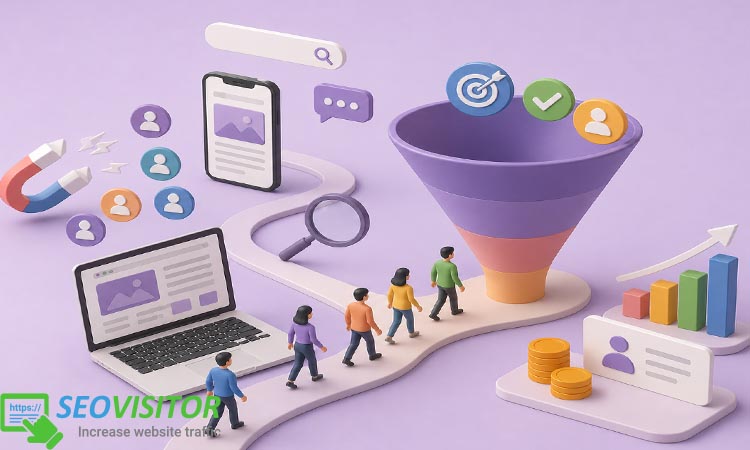
Eight Practical Ways to Attract More Qualified Visitors
- Match content to search intent. Review the pages that currently satisfy the query and identify whether users expect a guide, comparison, product page, calculator, or service page. Build the format around that expectation rather than forcing a sales page into an informational search.
- Prioritize specific, relevant queries. Long-tail keywords often reveal the audience, problem, industry, or location more clearly than broad phrases. Search volume may be lower, but the query gives you more information about what the user actually wants.
- Create landing pages for distinct use cases. Separate audiences should not receive identical messaging. Build focused pages for important industries, locations, services, or customer problems, and explain why the offer fits that specific situation.
- Strengthen organic discoverability. Use a clear page title, one descriptive H1, logical H2 and H3 sections, useful internal links, fast loading, mobile-friendly layouts, and crawlable navigation. Google’s guidance emphasizes creating reliable, people-first content rather than pages made primarily to attract search traffic. people-first content should remain the foundation of the strategy.
- Promote content where the audience already participates. Industry newsletters, professional communities, relevant forums, podcasts, and partner publications can produce highly qualified referral traffic when the contribution is genuinely useful and the placement fits the audience.
- Use paid acquisition as a controlled test. Paid traffic is most useful when the team defines the audience, landing page, conversion event, budget limit, and stopping rule before launch. When a business evaluates targeted website traffic services, it should verify traffic sources, geographic controls, reporting transparency, and the absence of automated or incentivized visits before scaling.
- Use geographic targeting carefully. Target only the markets the business can serve, and exclude irrelevant regions where the platform allows it. Google notes that location targeting relies on multiple signals and is not perfectly accurate, so performance should still be reviewed by country and region.
- Improve the page that receives the traffic. A relevant visitor can still leave if the page is slow, vague, or difficult to trust. Clarify the value proposition, show evidence, answer objections, reduce form friction, and provide one primary call to action.
Use the RACE Framework to Audit Traffic Quality
A useful traffic audit should combine four dimensions. Score each dimension from 0 to 2 for every major channel or campaign. The score is not a universal benchmark; it is a consistent way to compare your own sources over time.
- Relevance: Do the queries, placements, locations, and audience characteristics match the offer? A score of 0 means little connection; 2 means strong alignment.
- Attention: Do visitors reach important sections, view another relevant page, or complete a useful micro-action? Interpret engagement in context rather than treating time on page as a ranking factor.
- Conversion: Does the source produce qualified leads, purchases, trials, calls, or another outcome that matters to the business?
- Efficiency: After including media cost, content cost, sales effort, refunds, and lead quality, does the channel create acceptable value?
A source scoring well on relevance but poorly on conversion may reveal a landing-page or offer problem. A source scoring poorly on relevance should usually be narrowed or stopped before the page is redesigned. This distinction prevents teams from blaming the website for a targeting failure—or blaming the traffic source for a weak offer.
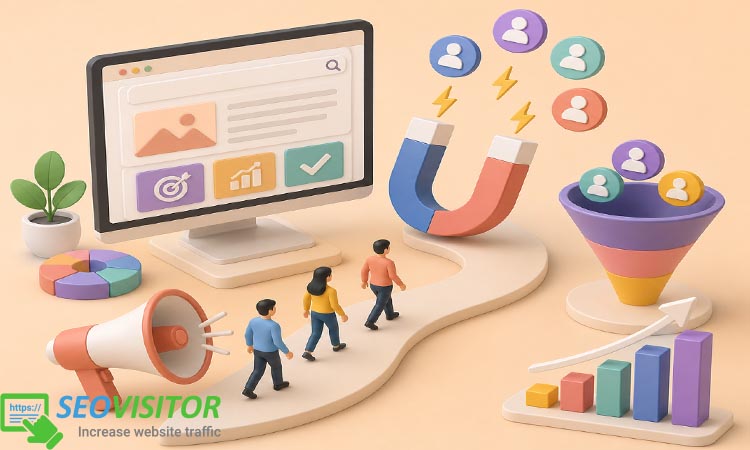
Measure Traffic Quality With the Right Reports
Begin in the Google Analytics 4 Traffic acquisition report and compare source/medium or channel groups. The report is designed to show where new and returning visitors come from across organic, paid, referral, and other sources. Google’s Traffic acquisition documentation explains how the report is organized.
For organic search, use Search Console to compare queries, pages, countries, devices, impressions, clicks, and click-through rate. Search Console and Analytics answer different questions: Search Console explains how a page performs in Google Search, while Analytics shows what happens after users arrive. Search Console’s Performance report is especially useful for finding the queries and pages that attract the audience.
Build a simple channel scorecard using the same conversion definitions and time period for every source. Include qualified conversions, conversion rate, cost per qualified conversion, relevant geography, and any micro-conversion that reliably precedes a sale. Avoid comparing channels with different attribution windows or incomplete tracking as if the numbers were equivalent.
A Simple 30-Day Traffic Quality Test
Before scaling any channel, run a short validation period with one audience, one landing page, and one primary conversion. Keep the budget and success criteria fixed so the result is clearly interpretable.
Week 1—Baseline
Confirm analytics events, UTM parameters, form tracking, call tracking, and bot filters. Record current conversion and lead-quality data before changing campaigns.
Week 2—Launch
Send traffic only to the most relevant page. Do not change the offer and audience simultaneously, because you will not know which change affected results.
Week 3—Diagnose
Segment results by source, query, location, device, and landing page. Review actual leads or orders instead of relying only on dashboard totals.
Week 4—Decide
Continue sources that produce qualified outcomes, refine sources with strong relevance but weak conversion, and stop sources that remain irrelevant after basic targeting corrections.
Document the decision and the evidence behind it. Repeating this process creates a reliable benchmark for future campaigns without depending on borrowed industry averages. Use the same attribution window throughout the test to keep comparisons consistent.
Warning Signs That You Are Attracting the Wrong Audience
- The page attracts impressions for unrelated queries. Update the title, headings, copy, or keyword targeting so the promise matches the offer.
- Traffic grows but qualified actions do not. Segment by source and campaign before assuming the entire website is underperforming.
- Visitors arrive from markets you cannot serve. Tighten location settings, exclusions, language targeting, and referral placements.
- A campaign produces engagement but no buying signals. Check whether the content answers an early-stage question and needs a clearer path to a commercial page.
- Lead volume rises while sales teams reject the leads. Measure qualified leads and downstream revenue rather than form submissions alone.
- One source reports unusually high traffic with almost no verifiable behavior. Audit the provider, placement, UTM tagging, geography, device mix, and bot filtering before spending more.
When Geographic Targeting Makes Sense
Country-specific traffic is useful when the offer, pricing, shipping, language, compliance requirements, or sales operation is designed for that market. A company targeting the United States, for example, should use locally appropriate language and proof, display clear currency and delivery information, confirm support coverage, and measure performance by state or region where possible. It should not assume that every visitor from the country has high purchasing intent.
The same principle applies to any market: geography is one layer of qualification, not a substitute for intent. The strongest campaigns combine location with a relevant query, audience profile, suitable landing page, and measurable business outcome.
Should You Pursue More Traffic or Better Traffic?
The answer depends on the business model. Publishers funded by advertising may benefit from broad reach if the audience is genuine and engaged. Service businesses, SaaS companies, and online stores generally need a closer connection between the visitor and the offer. Even then, quality and volume are not opposites. Once a channel consistently produces qualified outcomes, increasing its reach becomes a sensible growth strategy.
A practical sequence is to prove relevance first, improve the landing page second, and scale volume third. This order produces clearer learning and reduces the cost of sending more visitors into an unproven funnel.
Conclusion: Attract the Right Visitors Before You Scale
Sustainable traffic growth begins with audience clarity. Define the customer, understand the intent behind the visit, match each channel to the right page, and measure outcomes that connect to the business. Pageviews and sessions remain useful, but they are inputs—not the final definition of success.
When traffic quality is evaluated through relevance, attention, conversion, and efficiency, marketing decisions become easier to defend. The goal is not to eliminate every imperfect visit. It is to steadily increase the share of visitors who can genuinely benefit from the offer and to scale only after that connection is visible in the data.
Frequently Asked Questions
Targeted website traffic comes from people whose intent, needs, location, or audience characteristics align with the content or offer on the destination page. Its quality should be confirmed through behavior and qualified outcomes rather than assumed from the source alone.
Compare the source’s queries or audience settings with the offer, then review meaningful engagement, qualified conversions, geography, and cost per outcome. Use the same definitions and time window when comparing sources.
No. Either channel can be well targeted or poorly targeted. Paid traffic can provide fast, controlled tests, while organic search can build durable discovery. Quality depends on audience alignment, source transparency, landing-page relevance, and the resulting business outcomes.
No. Location can remove irrelevant markets, but it does not prove interest or buying intent. Geographic targeting works best when combined with relevant messaging, search intent, language, offer availability, and conversion tracking.